Thursday, May 26, 2011

66. Restaurant Review: Ristorante Stefano (Kagurazaka)

Want delicious, authentic, Venetian-style Italian food in Kagurazaka; then visit Ristorante Stefano. You can't go wrong when Stefano himself is very 'hands-on' in this quaint little bistro.

The atmosphere is warm, with dark wood beams crossing a white ceiling, and walls half wood and half 'beige-clay' colored. Table cloths are also beige, and wood chairs are covered in a European-style burgundy print. There are fresh flowers on every table, and candles which are lit in the evening. Decorations are minimal, with simple plates and masks from Venice adding to the ambiance. Italian music plays lightly in the background; while during the day, two frosted windows let in light, but cannot be seen through.

There is seating for about 24. Most tables are for two, but can be pushed together for larger parties.

Upon being seated, I was brought a green glass bottle filled with cold water. Although the sets are explained in English, the menu items themselves are only in Italian and Japanese. However, they were not so difficult to figure out and if you have any doubts, ask Stefano to explain them to you, he speaks wonderful English.

I ordered the least expensive lunch set, the Mezzo. It included a choice of appetizer, choice of pasta, a side of bread, coffee (or tea), and dessert for 2100 yen. I also ordered a glass of the house red wine which was 730 yen.

The wine was very good, and was served at room temperature. My appetizer choice was asparagus wrapped in bacon and topped with a slightly cooked egg, which I broke open to allow the yolk to run all over. Not the lowest calorie choice, I know. But, absolutely melt-in-your-mouth! The lady next to me had a large, tasty-looking salad.

I was given a small basket filled with three types of bread; focaccia (they alternate, rosemary or oregano), a whole grain, and a short, dry 'cracker' called grissini. All were baked on the premises.

The pasta I chose was gnocchi with rucola, tomatoes, and mozzarella cheese in an olive oil sauce. Absolutely delicious, but I would not choose this appetizer and pasta combination again as both were very rich. Maybe I'll have the salad next time...

After lunch I was given a choice of a multitude of different coffee and tea choices. I had the ice coffee, but only because the temperature in the restaurant was a little warm. I don't know if it was warm on purpose (the clientele was 90% Japanese women, who are always cold), or if it was just that day. I plan to visit again (and again) and I hope it is cooler next time.

Dessert was a beautifully presented pannacota with a small slice of apple tart. It was garnished with cream, fresh mint, and some tasty sauces.

Stefano constantly made the rounds, conversing with all of the patrons and often serving the dishes himself. He was charming and explained the ingredients of each dish.

There are three lunch sets to choose from. The Mezzo, mentioned above. The Pieno, same but add a main course (3150 yen). And, the Stefano Special Course - daily specialties for 4200 yen. Customers can also choose from the a la carte menu and they will receive 10% off during lunch time.

**THIS REVIEW WAS WRITTEN IN 2009.  THIS IS A COPY OF AN UPDATED LUNCH MENU.
In the evening, choose from an a la carte menu, which is divided into Venetian traditional dishes and Stefano’s Veneto specialties, in addition to daily specials. There is also a fixed course at 8500 yen, or choose from a variety of courses starting at 4500 yen. A 500 yen table charge includes dessert plate and coffee/tea.

I highly recommend Ristorante Stefano if you are in Kagurazaka and have a craving for Italian!
UPDATE:  I recently met someone from the Italian Embassy and I asked them for their three favorite Italian restaurants - Stefano's was one of them!
Hours of Operation:
Tues - Sat. 11:30 - 14:00 (last order) / 18:00 - 22:00 (last order)
Sun. 12:00 - 14:00 (last order) / 17:30 - 21:00 (last order)
Closed on Mondays.

Address: Terui Bld. 1F, 6-47 Kagurazaka
*One minute walk from Kagurazaka Station (Kagurazaka Exit). Beside 'Softbank'. Down a long, slightly dark corridor. Look for the menu posted on a podium near the sidewalk.

Phone:  03-5228-7515
Website:  http://www.stefano-jp.com/

NEW INFORMATION:  Stefano has opened a more casual establishment just up the slope from Ristorante Stefano.  It is called 'Brusca'.  They occasionally have live music.  See the above website for more information.

Address:  Hosoya Bld., 2F, 107 Yarai, Shinjuku Ward, Tokyo
Phone:  03-6457-5788, closed on Monday

Friday, November 19, 2010

65. Museum Review: Hara Museum of Contemporary Art

Founded in 1979, the Hara Museum was one of the first contemporary art museums in Japan.  Located in Shingawa Ward, the building was originally a private residence constructed in 1938. 

The entrance to the museum is surrounded by lovely shade trees, and a number of exhibits are scattered around the lawn.  Inside are two floors containing 5 gallery spaces and a cafe overlooking a grassy space that contains more exhibits and outdoor seating. 
 
The museums's collection comprises of about 1,000 works by leading and upcoming artists from around the world.  In addition to permanent sculptures in the garden, there are some very interesting permanent exhibits inside including 'My Drawing Room' by Yoshitomo Nara and 'Time Link' by Tatsuo Miyajima. 
By the way, when you wander the museum, don't hesitate to open any doors that you see.  Except for the obvious (toilet, office), behind most doors are exhibits themselves. 
On my most recent visit, the museum was holding a special exhibition for Jae-Eun Choi called 'Forests of Asoka'.  I often find the exhibits here to be quite bizarre, but was pleasantly surprised with Choi's work.  *Her exhibit runs through December 26, 2010.
This museum never seems to be busy, and they offer a couple of really tasty lunch specials, as well as some yummy desserts.  Although I don't find the garden space (above) to be that impressive, it is a quiet oasis in the city.  The garden/park of Gotenyama is directly behind the museum and entry is free.

Address:  4-7-25, Kitashinagawa, Shingawa Ward
Phone:  03-3445-0651
Hours of Operation:  11:00am - 5:00pm, Wednesdays until 8:00pm.  *Last entry 30 min. before closing.
Closed:  Mondays
Admission:  1000 yen (general), 700 (high school and univ student), 500 yen (elem and Jr high).
*Free for students through high school every Saturday during the school terms.

Directions:  5 minutes by taxi or 15 minutes by foot from Shinagawa Station (Takanawa Exit).  Or, from the same station, take the No. 96 bus, and get off at the first stop (Gotenyama), and walk 3 minutes.

Monday, August 2, 2010

64. Museum Review: Shiodome Museum / Rouault Gallery (Shiodome)

When Panasonic opened their new headquarters in Shiodome in 2003, they also opened the Shiodome Museum to showcase the paintings and prints of the twentieth century French painter Georges Rouault (1871-1958).  Their collection, which consists of approximately 200 of his works, have been collected by the company as part of its cultural contribution to society.
A rotating selection of Rouault's work is on permanent display, and the museum periodically holds special exhibitions relating to the artist. In addition, the museum holds exhibitions on themes corresponding to the actual undertakings of the company, such as "architecture and living" and "life and design."
The current exhibition, Hans Coper Retrospective - Innovation in 20th Century Ceramics, runs from June 26, 2010 - September 5, 2010.  Hans Coper was one of the masters of British ceramics in the 20th century.  If you've never seen his work, this is a great opportunity - It is impressive and  very original.
The museum itself is very quiet (very few people know of its existence), well laid out, and easy to get to. 
Hours of operation:  10:00 am - 6:00 pm (Entry until 5:30 pm).  Closed on Mondays (excluding holidays), New Year holidays, museum summer holidays, and during changes of exhibits. 
Admission:  Adults:500/ Senior high school and college students:300/ Elementary school and junior high school students:200/ Seniors:400     (Different fees may be charged during special exhibitions.)
Address:  Shiodome Museum   4F Pansonic Electric Works Tokyo Headquarters, 1-5-1 Higashi-Shimbashi, Minato-ku, Tokyo, 105-8301
Phone:   03-5777-8600

Access:
Five-minutes' walk from Ginzaguchi Exit of JR Shimbashi Station.
Three-minutes' walk from Exit 2 of Shimbashi Station on the Tokyo Metro Ginza Line.
Three-minutes' walk from the ticket wicket of Shimbashi Station on the Toei Asakusa Line.
One-minutes' walk from Exits 3 and 4 of Shiodome Station on the Toei Oedo Line
Website:  http://panasonic-denko.co.jp/corp/museum/en/

Thursday, April 15, 2010

63. Museum Review: Taro Okamoto Memorial Museum

Taro Okamoto was Japan's pioneer in avante-garde art.  He was a painter, photographer, sculptor, designer, and more!  Influenced by Picasso at a young age, his art was radically different than anything a Japanese had ever created before. 

Here is a very interesting video about him:  http://www.youtube.com/watch?v=bTOwzRiQvHU
The Taro Okamoto Memorial Museum in Minami-Aoyama was Okamoto's home and studio for over 40 years. He lived there until his death in 1996 at the age of 84.  The museum has over 600 pieces, including a 140cm prototype for his 'Tower of the Sun', which is a 70 meter tall sculpture created as the symbol of the 1970 Osaka Expo.
In addition to displaying his works, the museum kept Okamoto's studio and garden intact. 

A small cafe called 'A Piece of Cake' sits next to the garden and it is not necessary to pay the entrance fee to enter either.  The day I was there a Japanese mom had brought her daughter to the garden to color (see photo below).  Obviously inspired, the two of them were drawing vigorously!    
Many of the paintings here are unfinished works as Okamoto had already donated over 1,800 of his pieces to the city of Kawasaki before he passed away.  You can see my entry on that museum here:  http://kanagawareviews.blogspot.com/2007/04/museum-review-taro-okamoto-museum-of.html

Even if you are not a fan of this type of art, the museum is a quiet, and interesting, oasis not far from Omotesando. 
 
Admission:  600 yen for adults, 300 yen for elementary school students
Hours of Operation:  10am - 6pm (last entry at 5:30).  Closed on Tuesdays and during the New Year's holidays.

Address:  Minato-ku, Minami Aoyama 6-1-19, 8 minutes walk from Omotesando Station.
 Use exit A5, go right.  Walk down to the third traffic light and turn right (the Nezu Museum will be in front of you).  Walk straight, and just before the main street (and traffic light), make a right. 
Phone:  03-3406-0801
Website:  http://www/taro-okamoto.or.jp/  (Japanese only)

Wednesday, December 2, 2009

62. Museum Review - Nezu Museum

Recently re-opened after a three year renovation, the Nezu Museum is an incredible oasis within Tokyo. The industrialist and President of Tobu Railway, Kaichiro Nezu, originally opened this museum at his private residence in 1941. The museum and grounds cover more than 20,000 square meters. Within that space are the museum itself, a large Japanese garden, several tea houses, and a small cafe.

The museum is divided into 6 galleries:
1) Special Exhibitions
2) Paintings and Calligraphy
3) Sculpture
4) Bronzes
5) Decorative Arts
6) Tea Arts
The collection also includes lacquerware, bamboo crafts, ceramics, metalwork, textiles, and archaeological materials. Altogether the museum possesses over 7,000 pieces, including 7 works designated as National Treasures, 87 Important Cultural Properties, and 96 Important Art Objects. The museum's most famous pieces are its ancient Chinese bronzes and a folding screen of irises by the 17th century artist, Korin Ogata.

The current special exhibition (11/18/09 - 12/23/09) is 'Nezu Seizan: Tea and Art'. Mr. Nezu was an enthusiastic practioner of tea ceremony and he was famous for his end of year 'tea parties' and his incredible collection of tea related artifacts.
All exhibits are labeled in English.
This was my first visit to the Nezu Museum, and I was not disappointed. I was very impressed by the building itself, and its exhibits. But the garden took me completely by surprise. I have visited most of the gardens in Tokyo and this is now my very favorite. It is especially beautiful in the fall.
Unbelievably, it is just down the street from Aoyama-dori and Omotesando Station!
Address: 6-5-1 Minami Aoyama, Minato-ku, Tokyo 107-0062

Getting there: 8 minute walk from exit A5 of Omotesando Station of the Ginza, Hanzomon, and Chiyoda subway lines. It is also 5 minutes from Minami Aoyama 6-chome Bus stop on the Metropolitan Bus Shibu 88 that runs between Shibuya and Shimbashi Stations.

Entrance fees: 1000 yen for regular collection, 1200 for special exhibitions

Hours of Operation: 10am - 5pm (last entry at 4:30). Closed on Mondays, during exhibition installations, and during the New Year's holiday period. When a National Holiday falls on a Monday, the museum is open on that Monday and is closed the next day.

Website: http://www.nezu-muse.or.jp/ *They have a fantastic English website, and the curator speaks perfect English.

I highly recommend this museum to anyone interested in Japanese culture, art, and gardens


Thursday, October 1, 2009

61. Transportation Review: Tokyo Shitamachi Bus

The Tokyo Shitamachi Bus is a new bus service for the touristy 'downtown' sections of the city. The bus runs back and forth between Tokyo Station and Ryogoku and costs 200 yen per ride for adults (100 for children). They also offer a one-day Toei Bus pass for 500 yen (250 for children), which includes some really good discounts at locations along the route. The pass is good for the Shitamachi bus, and all other Toei buses.

The bus itself has been designed in a retro style, with a large round window on both sides of the back. If you ride the bus, sit beside one of these windows for the best views. Pay or show your pass when you get on the bus, press a button before the stop you want, to get off. Be sure to grab the two English brochures on the bus, they contain a lot of helpful information and good maps.

There are tv's on the bus with English subtitles and stops are announced in a number of different languages. Buses run daily at 30 minute intervals from 9:00 am to around 6:00pm. If you go from end to end, it takes about one hour. The ride is pretty slow, but it gives a good view of the area.

Bus stops are marked in Japanese and English with a sign that says 'tokyo shitamachi bus'.

Here are the stops:

1) Tokyo Station (Marunouchi North Exit)
2) Nihombashi Mitsukoshi
3) Sudacho (Akihabara) - on weekdays and Saturdays
Manseibashi (Akihabara) - on Sundays and holidays
4) Ueno Koen (park) Yamashita / Ueno Station
5) Kikuyabashi (Kappabashi Dogugai Street)
6) Asakusa Kaminarimon
7a) Ryogoku Station
7b) Toei Ryogoku Station (Edo-Tokyo Museum)

I highly recommend this bus to tourists (and locals alike), especially for an entire day of sightseeing in Shitamachi. 500 yen for a day pass (with discounts at locations along the route) is an excellent deal!

*By the way, the Ryogoku Station bus stop is just outside and down the street a little from the West Exit. Just behind the bus stop is a tiny tourist center with really good walking maps of Ryogoku. The maps do not have any English writing on the outside of them, but the map inside is labeled in Japanese and English. Currently the outside of the brochure is burgundy with mostly white printing and a wood block print picture. Be sure to get one!

Wednesday, August 26, 2009

60. Temple Review: Tsukiji Honganji

The Tsukiji Honganji Temple dates back to 1617 when Junnyo Shonin, the 12th leader of the Jodo Shinshu Sect of Buddhism in Kyoto, established a branch temple in Edo (Tokyo). Known at that time as the 'Edo-Asakusa Gobo', the temple burned down in the Great Fire of 1657. Permission to rebuild in the same spot was denied by the feudal government. Instead, an area of the shoreline of Hatchobori was reclaimed from the sea by devout followers, many who lived on nearby Tsukudajima. The word Tsukiji means 'built up land', so the temple came to be called 'Tsukiji Gobo' and the district around it became known as Tsukiji.The temple was destroyed again in the Great Kanto Earthquake of 1923, and it was rebuilt from 1931 to 1934 with an Indian architectural motif designed by Chuta Itoh, a professor of Architecture at Tokyo University. It will be observing the 750th memorial service of its founder in 2012.

Although the building is large and impressive looking from the outside, the temple grounds themselves are just a huge paved parking lot. Anyone is welcome to go inside, but as the hall is filled with cheap theater seats, it is not terribly impressive. There are English brochures available near the front door, and they explain the history of the temple and the important artifacts stored there. Unless you happen to be walking down the street or visiting Tsukiji Fish Market, I would not go out of my way to visit this temple.
Monthly Dharma talks in English are held generally on the last Saturday from 5:30pm. There is more information on their website: http://www.tsukijihongwanji.jp/
Morning and evening worship services (in Japanese) are held daily at 7:00am and 4:00pm. There are also special services throughout the year (New Years, Buddha's Birthday,...).
Address: 3-15-1 Tsukiji, Chuo-ku 104-8435, Tokyo
Phone: 03-3541-1131
Getting there: Hibiya Line to Tsukiji Station. Or, the Oedo Line to Tsukiji-shijo Station.


Monday, April 27, 2009

59. Restaurant Review: L-Atelier de Joel Robuchon (Roppongi Hills)

A sister restaurant to the chef's Paris location, L'Atelier de Joel Robuchon is a welcome addition to Tokyo. The French restaurant is 'Roppongi Hills Casual' (meaning: not that casual) and most guests are seated at a long bar counter that overlooks a completely visible kitchen. There are also three tables that can seat four each.

Sit at the counter, the show is better. The shiny silver (spotlessly clean) kitchen is full of activity, with a staff dressed in all black working in perfect coordination.

I was there for dinner with my husband. We started with a few appetizers including the best shrimp I have ever eaten in my life. It was lightly battered and fried and it melted in my mouth. Pricey at 1000 yen each, but I'd order them again.

My main dish was a marinated white fish (3,200 yen), my husband had lamb chops (3,900). Both absolutely delicious. We stopped there, but all of the French people around us (there were quite a few) had a cheese plate with bottles of wine, then coffee,...

Glasses of the house red were 1,300 yen, a 500ml bottle of Evian, 700 yen.There is a 10% service charge, and our bill came to 16,389 yen. Not somewhere you could eat on a regular basis. But, it was some of the best food I've ever eaten in Tokyo, I would recommend it, hands down.

Reservations are only accepted for lunch and early dinner.

Menus are in French and Japanese. If you don't read either, just pick anything - it all seems to be delicious.

Address: Roppongi Hills Hillside, 2nd Floor, 6-10-1 Roppongi
Hours of Operation: 11:00- 22:00 (last order is at 22:00).
Tel: 03-5772-7500
http://www.robuchon.com/

Next door is the Robuchon Boutique, which sells traditional French breads and pastries.

58. Restaurant Review: K-Shiki (Mandarin Oriental Hotel)

With incredible views of Tokyo from the 38th floor, K'Shiki is a restaurant in the new Mandarin Oriental Hotel. It has an elegant Japanese feel, with huge windows overlooking the city.

I visited this restaurant in a group of 25, and it was strongly suggested that we order the Mandarin Lunch Set. Three members that were unable to eat seafood ordered a pizza set instead, but the rest of us never saw a menu.

The lunch was 'Asian-inspired'. First, an appetizer of raw? scallops and octopus, cut into tiny pieces and mixed together. Perhaps a dish the Japanese would really like, it was not a big hit for our American crowd. Next was a wasabi flavored cream risotto with seaweed sprinkles. I found it quite tasty, but two of the ladies close to me only had a bite.

The main dish was a choice of roasted tenderloin or sea bream in a rice cracker coating. Both of these entrees were excellent. For dessert we had some vanilla bean ice cream and a fried wonton stuffed with chocolate. Everyone liked the ice cream (of course), but the wonton with chocolate was not that tasty. We also had a choice of tea or coffee.

Considering that the Mandarin Oriental is a major international hotel chain, I think they should have thought twice about recommending this set to our group. Americans are not known for having adventurous palettes. I have lived in Japan for 11 years, and even I wish that I had been given a different choice.

Service was excellent, although I felt there was too much of a gap between when we finished and when the desserts and coffee/tea arrived. Also, when asked if we preferred separate checks, we said 'yes'. I don't think they anticipated a 'yes' and there was quite a bit of commotion. We did get our separate checks, though.

The Mandarin Lunch Set was 3500 yen with a 10% service charge (a 5% consumption tax was already included). I will never understand why there has to be a service charge. Almost nowhere else in Japan is one ever included. I always feel cheated when foreign hotel chains insist on this practice. Since we had just completed a tour of the spa and they were courting our business, we did receive a 10% discount on our meal. That took care of our service charge, but everyone else in the restaurant still had to pay one.

I also ordered their least expensive glass of wine (1400 yen). One coke was ordered (900 yen). With drink prices so high, our other 23 members just drank water.

Although the view was magnificent, I doubt I will eat here again. I may, however, bring guests from overseas to the hotel. Perhaps we'll have better luck at one of the other restaurants, or maybe we'll just have drinks. For those who don't want to spend a lot of money for the view, just stand in the lobby. Or, even better, go to the bathroom. Definitely one of Tokyo's best free views of the city!

Sunday, April 26, 2009

57. Area Review: Sangenjaya (Setagaya)

Just outside of Shibuya on the Den-en-toshi Line is Sangenjaya, which means 'three tea houses'. The area was given this name because travelers from the countryside would stop here on their way into Tokyo. The tea houses are gone, and although there are a number of nice shops/restaurants in the area, there are three main reasons to visit:

First, it is a starting/ending station of the Tokyu Setagaya Line, one of only two remaining streetcars in Tokyo.

Second, is the Carrot Tower. It is Setagaya Ward's tallest building, and as it was built to attract people to Sangenjaya and the ward itself, it has a free observatory on the 26th floor.
There are many observatories in Tokyo, but I like this one because Sangenjaya lies outside of the Yamanote Line and their are no other tall buildings nearby. It gives a very unique perspective of the city.

The best way to enjoy the observatory is to have lunch there. Since the Carrot Tower is owned by the Setagaya Government, the restaurant has a cafeteria feeling, but the view and tasty food more than make up for its lack of style. The menu is all in Japanese, but if you can read katakana, you can read most of the choices. Best of all, lunches start at only 1100 yen and usually include salad and coffee/tea.
The Setagaya Public Theatre is also located in the Carrot Tower. And, I am happy to say, they actually have an English website: http://setagaya-pt.jp/en/

The third reason to visit Sangenjaya is because it is home to one of Tokyo's two Samba Festivals (the other is in Asakusa). It is called the 'Sancha Matsuri' and in 2008 was held on August 23 and 24. The festival commemorates the historic relationship between Japan and Brazil, and it features an impressive Samba parade, live performances, and booths selling a wide variety of products.

Thursday, January 8, 2009

56. Transportation Review: Toden Arakawa Line

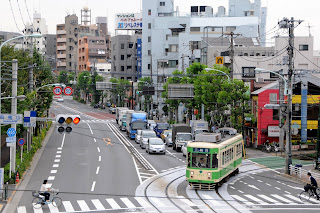
The Toden Arakawa Line, which originated in 1913, is one of only two remaining streetcars in Tokyo. It operates from Waseda Station in Shinjuku Ward, cutting through Toshima Ward and Kita Ward; before terminating at Minowabashi Station in Arakawa Ward.
On most of the 12 kilometer journey it runs along its own tracks; but it also runs along Meiji Dori between Asukayama Station and Oji Eki-mae Station. The entire ride takes about 50 minutes. It is a slow, and leisurely ride through some interesting sections of Tokyo's 'Shita-machi' (the traditional 'downtown').
Some interesting stations for explorations include:

*Waseda - home of Waseda University, one of the top private universities in Japan. The campus is open to the public and is covered with many trees.

*Zoshigaya - Zoshigaya Cemetery and Gokokuji Temple

*Koshinzuka - Sugamo, the 'Harajuku' of the elderly

*Asukayama - Asukayama Park and it's museums

*Arakawa-yuenchimae - Children's amusement park

*Minowabashi - very 'downtown' atmosphere with once popular shotengai covered shopping arcade

A ride along the Arakawa Line costs a flat 160 yen, no matter how far you go. I recommend buying the 'Ichinichi Josya Ken' for 400 yen. With this ticket, you can hop on and off the train as much as you like for one day.

To see a map of the streetcar (with connecting train lines), use this link:
Exploring along the Arakawa Line is a great, inexpensive way to spend the day!


Tuesday, November 18, 2008

55. Museum Review: Hatoyama Kaikan (Bunkyo-ku)

The Hatoyama Kaikan was once the residence of the famous Hatoyama family. A Western style residence that was built in 1924, it had fallen into disrepair, but was renovated and is now a memorial hall commemorating the Hatoyama family's contributions to politics and education in Japan.
The Hatoyama's have been active participants in Japanese politics for many years. Most recently, Kazuo Hatoyama (1856 - 1911) was once Vice-Foreign Minister, Speaker of the House of Representatives, Tokyo University professor, and the President of Waseda University. Ichiro Hatoyama (1883 - 1959) was once Secretary of the Cabinet, Minister of Education, and a Prime Minister. Iichiro Hatoyama (1918 - 1993) was once the Vice-Minister of the Ministry of Finance, member of the House of Councilors, and Minister of Foreign Affairs. Yukio and Kunio Hatoyama are currently members of the House of Representatives.

The home was built by Ichiro Hatoyama, and it was here that he helped form the present Liberal Democratic Party.

There are currently three memorial rooms; one dedicated to Ichiro, another to his wife Kaoru, and another to Iichiro Hatoyama. There are also some lovely sculptures of Kazuo, and his wife, Haruko, in the garden.

Haruko founded what is now Kyoritsu Women's University, and she contributed to women's education for many years. Kaoru Hatoyama became schoolmaster of Kyoritsu Women's University.
The residence has some very beautiful stained glass windows, and a lovely rose garden. I don't think the home is impressive enough to go out of your way to see. But, it is a short distance from Chinzanso, Edogawa Park, and Gokokuji Temple. In combination, they would be a nice sightseeing choice.
Entrance Fees: adults 500 yen, older students 300 yen, elementary and Jr. high students 200 yen. Discounts for the elderly and groups of 20 or more.
Address: Bunkyo-ku, Otowa 1-7-1

It is a 7 minute walk from the 1a exit of Edogawa Station. And, an 8 minute walk from exit #5 of Gokokuji Station.

Hours of Operation: 10:00 - 16:00 (last entry at 15:30). Closed on Mondays.

Wednesday, June 4, 2008

54. Museum Review: The Baseball Hall of Fame & Museum (Bunkyo-ku)

Located within the premises of the Tokyo Dome, the Baseball Hall of Fame and Museum is for baseball lovers, especially those with an interest in Japanese baseball. The museum is divided into sections, all dealing specifically with baseball in Japan:

1) Highlights and New Acquisitions
2) Professional Baseball
3) History of Baseball
4) Amateur Baseball
5) Baseball Hall of Fame
6) Special Exhibitions
7) Event Hall - Hands on Baseball Experience
8) Library

Very few of the exhibits are labeled in English, but I was given an extremely thorough pamphlet on my way in.

I don't have much to say about this museum because I do not have any interest in Japanese baseball. It was well put together, exhibits were easy to see,... but I really only recommend this museum to those who like Japanese baseball, otherwise most of the memorabilia has little significance.

Admission: Age 6-15: 200 yen; Adults: 500 yen; Age 65 and up: 300 yen

Hours of Operation:
March - September: 10am - 6pm
October - February: 10am - 5pm

Closed most Mondays and during the New Year's holidays.

Address: 1-3-61 Koraku, Bunkyo-ku 112-0004
*The entrance is located to the right of Gate 21 of the Tokyo Dome.

Phone: 03-3811-3600

They do have an excellent English website: http://english.baseball-museum.or.jp/index.html

Wednesday, March 19, 2008

53. Amusement Review: Tokyo Dome City (Bunkyo-ku)

A section of Bunkyo Ward, Koraku is an entertainment playground. The centerpiece is the famous Tokyo Dome, but it is surrounded by an area called 'Tokyo Dome City'.

An amusement park takes up a large part of this area. Rides seem to hang over the city streets, and they actually go through buildings and each other! They can all be ridden separately, or an 'all you can ride' pass can be purchased. The amusement park is built into the Tokyo Dome City, so it is free to walk around the rides.
Built halfway around the amusement park is 'La Qua', a building filled with over 70 shops and restaurants. There is also a natural hot springs spa built into the upper floors.

Towering over everything is the 155 meter Tokyo Dome Hotel. I recommend having the buffet lunch at the 'Artist's Cafe' on the 43rd floor. Named after the artists that perform in the Tokyo Dome, make sure you reserve ahead of time to get a table right by the window. The city views are fantastic! If you are in the area at night, stop by the bar for the same great view, often with live music performances.

Also within the Tokyo Dome City is the 'Japanese Baseball Hall of Fame and Museum' (see next review). The Tokyo Dome itself hosts over 60 baseball games a year, as well as a number of other sporting events (boxing, American football, monster trucks,...). There are also special exhibitions, the most famous being the yearly 'International Great Quilt Festival' held every January (photo below).

The Tokyo Dome City also contains the largest JRA WINS horse race betting complex in Tokyo. Here you'll see many down-on-their-luck Japanese men hanging out, smoking heavily, trying to win their way out of disfortune. A large game center is beside WINS, in addition to games there are batting cages, bowling, and more.

For English information on everything I've mentioned, visit this site: http://www.tokyo-dome.co.jp/e/dome/

Access: Tokyo Dome City is located in the southwest corner of Bunkyo Ward. Korakuen Station (on the Marunouchi and Namboku Subway Lines) and Suidobashi Station (Mita Subway Line and JR Chuo Line) puts you right in the center of the 'City'. It is also a very short walk from Kasuga and Iidabashi Stations. Here is a nice map of the area:
http://gmap.jp/shop-11397.html

52. Garden Review: Koishikawa Korakuen (Bunkyo-ku)

Koishikawa Korakuen is one of Tokyo's oldest and most beautiful Japanese landscape gardens. The Tokugawa daimyo (feudal lord) Yorifusa Mito began construction of the park in 1629. It was completed by his successor, the famous Mitsukuni Mito, as part of his daimyo yashiki (feudal lord residence). Mitsukuni Mito was interested in Chinese teachings, so he named the garden 'Korakuen'. Koraku means 'enjoying afterwards', from a Chinese proverb stating 'a governor should worry before his people and enjoy after his people'. The landscape design incorporates a mix of Chinese and Japanese influences.When built, the residence helped guard the approach to Edo Castle from the north. It also protected the Kanda Aqueduct, Edo's main water source. There was an arsenal at this location from 1867, and it was eventually turned into a public park and national historic site in 1952.
This photo shows an area of the garden where rice was planted, raised, and harvested by Mitsukuni Mito's son. Mitsukuni thought it was important for his son to know how difficult it was to grow the precious crop.

I recommend doing some research on Mitsukuni Mito before visiting this garden. Many TV series have been created about this incredible man, the most famous is the fictionalized 'Mito Komon'.

Admission: 300 yen
Open everyday, except during the New Year's holidays
Hours of Operation: 9:00 - 17:00

Address: Koraku 1-6-6, Bunkyo-ku
A short walk from Iidabashi or Korakuen Stations. It is right behind the Tokyo Dome.
Phone: 03-3811-3015

Monday, February 18, 2008

51. Park Review: Shioiri Park (Arakawa-ku)

Minami-Senju is not a popular area of town for tourists. It is right in the middle of Tokyo's 'Shita-machi', older neighborhoods of the working class. This area of Minami-Senju, however, is brand new and so is Shioiri Park. Shioiri Park has all the basics: baseball fields, tennis courts, large grassy lawns, picnic & BBQ areas, and an excellent playground. Located along the Sumida River, there is also a lovely cycling course. I was also impressed that although the riversides are concrete, they left a nice section of reeds right at the waters' edge.I was surprised by, a huge, beautiful, traditional-style building that sits between the park and the Tokyo Metropolitan College of Industrial Technology. It is actually the 'Shirahige Nishi Pump Place', a water treatment facility. What a way to hide an unsightly necessity! (It is the large building on the left below).
Minami-Senju hosts a very large train freight depot. The Shioiri Park area lies just beside it, and the entire area, including all of the residences (mostly high-rise condos), are very new. I don't know what the area was before, but its 'renewal' is very impressive.

I recommend this park for those who want some wide-open space, but don't want to travel very far to find it!

The park is a short walk or bus ride from Minami-Senju Station. There is also reasonably priced parking available.
By the way, keep your eye out for English language tourist brochures of Arakawa Ward. They are excellent. I would never have know about this park if I hadn't read about it in their brochure.

50. Park Review: Arakawa Amusement Park (Arakawa-ku)

The Arakawa Amusement Park is one of Tokyo's best buys and a great place to bring small children! Originally a villa for the feudal lord, Todo Takatora, it is the only city-run theme park in the city of Tokyo. The site became a brick factory in 1872, and later was changed into 'Arakawa Gardens', a private park with amusement facilities. It was shut down during WWII, but reopened in 1950 as the current 'Arakawa Amusement Park'.
The park is not very large, but there are a lot of things for children to do. First, there are some rides including a small ferris wheel, merry-go-round, mini-train, and pedal-powered 'sky' cars.
There is also a roller coaster that is known as 'the slowest roller coaster in Japan'. It was perfect for the 7 year old I took on my second visit. It was the only ride we did twice!Also in the park is an 'Animal Plaza'. In addition to some caged animals (monkeys, birds,...), there is a great petting zoo. Kids get a chance to get up close and personal with goats, deer, sheep, rabbits, and really cute guinea pigs! On a second visit to the park, the petting zoo was kept clean, but the waste in some of the other cages needed to be dealt with.
Many were enjoying a couple of small fishing ponds. This area was quite popular with older elementary school boys and their fathers. The park also contains some grassy picnic areas, some fast food outlets, and some great blow-up 'attractions'. There was also a live music performance the day I was there (traditional Japanese drumming, flutes,...).

If you just want to look around, the entrance fee is 200 yen for adults, 100 yen for children. For 1400 yen, and adult and child can enter together and they receive 12 tickets. Each ride 'costs' one ticket for a child, two tickets for an adult. Extra tickets can be purchased if necessary.

Hours of Operation: 9:00 - 17:00, closed on Tuesdays

Tel: 03-3893-6003

Address: Nishi-Ogu 6-35-11, Arakawa-ku. Arakawa Ward is located just outside the Yamanote Line, above Ueno.

Transportation: The coolest way to get to the park is by the Toden Arakawa Streetcar, the last remaining streetcar in Tokyo. The train starts at Waseda or Minowabashi. It is also accessible by bus, by water cruise boat, and by car. Reasonable parking is available nearby.